
Roof flashing is one of the least noticed parts of a home, yet it protects the places where leaks begin. Shingles cover the open slopes, but the joints around chimneys, walls, vents and valleys need something more. When that protection weakens, water finds its way inside. This guide explains how flashing works, where it lives, why it breaks down and what a proper roof repair looks like.
What Is Roof Flashing?
Many homeowners ask what roof flashing is only after a stain appears on a ceiling. In simple terms, it is thin sheet metal fitted wherever the roof surface is interrupted. Common flashing materials include galvanized steel, copper, and aluminum.
Shingles cannot bend around a chimney or bridge the meeting point of two roof planes. Flashing takes over at these spots by overlapping the shingles on one side and the vertical surface on the other. It guides water back onto the roof rather than into the structure beneath it.
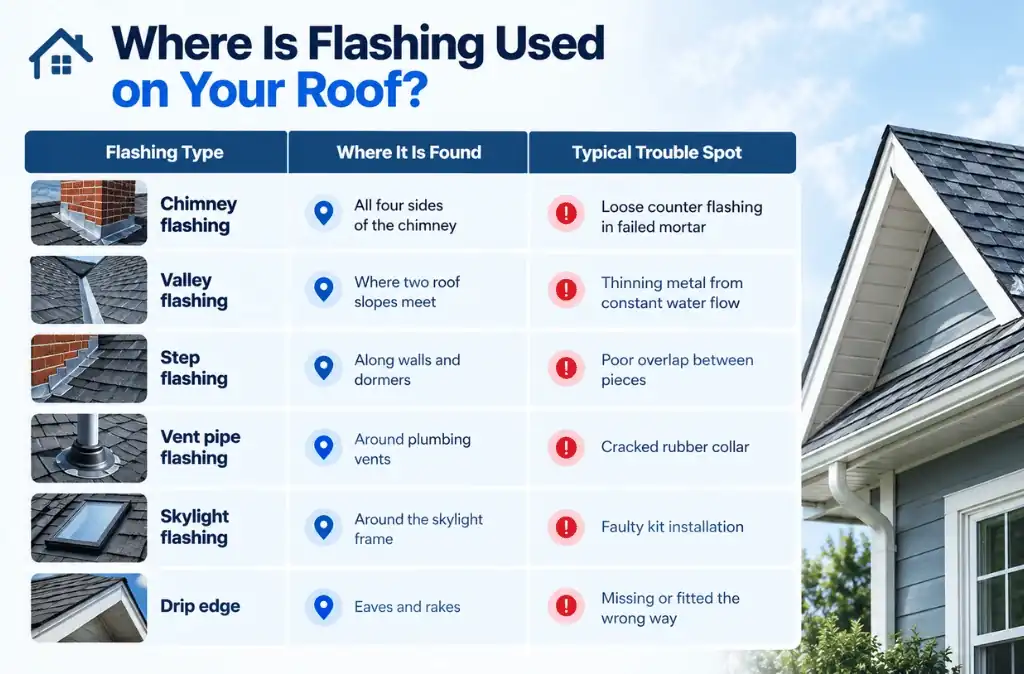
Where Is Flashing Used on Your Roof?
Chimney Flashing
Chimney flashing is a detailed installation on most homes because a chimney passes fully through the roof. You must seal four sides, and the work is done in two layers. Step flashing runs along the shingles at the sides and back.
Counter flashing sits in the mortar joints and folds down over the first layer to close the assembly. The mortar itself is often the weak point. As the joints crumble, the counter flashing loosens and lifts. Water then slides behind the metal and straight into the framing.
Valley Flashing
A valley forms wherever 2 roof slopes meet & funnel their runoff into one channel. That channel carries more water than any other part of the roof. Valley flashing sits beneath the shingles to move this concentrated flow safely to the eaves. When a valley fails, the leak usually shows on the ceiling directly below it.
Step Flashing Along Walls and Dormers
Wherever a roof slope meets a wall (vertical), such as beside a dormer, step flashing protects the joint. Install these small L-shaped pieces one per shingle course, each overlapping the one below. A strip of counter flashing or the wall cladding covers the top edge to finish the seal. Pieces set without enough overlap will let water into the wall cavity within a few seasons.
Vent Pipe Flashing
Plumbing vents pass through the roof, and each one needs a vent pipe flashing where it exits. The usual solution is a boot with a rubber collar that hugs the pipe and a flat base that sits under the shingles. Sun and temperature swings dry the rubber until it cracks, often after 10 to 15 years. Boot replacement is simple but often overlooked.
Skylight Flashing
Skylights need protection on all four sides where the frame meets the roof deck. Most manufacturers supply a matching kit, but it only performs as well as the person fitting it. Leaks at skylights are often blamed on the unit when the real cause is the metal around it.
Drip Edge Flashing
Drip edge is a long L-shaped strip fitted along the rakes and eaves. It sends runoff clear of the fascia instead of letting it curl back under the shingles. Its absence explains many rotted fascia boards.
Knowing the different types of roof flashing makes it easier to discuss repairs with a contractor. The table below sums up where each type sits and what tends to go wrong.
| Flashing Type | Where It Is Found | Typical Trouble Spot |
| Chimney flashing | All four sides of the chimney | Loose counter flashing in failed mortar |
| Valley flashing | Where two roof slopes meet | Thinning metal from constant water flow |
| Step flashing | Along walls and dormers | Poor overlap between pieces |
| Vent pipe flashing | Around plumbing vents | Cracked rubber collar |
| Skylight flashing | Around the skylight frame | Faulty kit installation |
| Drip edge | Eaves and rakes | Missing or fitted the wrong way |
Why Roof Flashing Fails
Understanding why roof flashing fails helps you catch trouble early. The causes below explain the most common roof flashing issues on residential roofs.
Age and Metal Fatigue
Metal expands and contracts slightly with every temperature change. Over decades, that movement fatigues the bends and seams until they crack or pull apart. Most flashing lasts twenty to thirty years, depending on material quality and exposure. Weathering also strips protective coatings, and corrosion follows.
Sealant and Caulk Deterioration
Many installations use sealant to close small gaps around edges. As a backup to proper metal overlap, that is fine. The trouble is that caulking rarely lasts more than ten years before it shrinks and peels away. Assemblies that rely on it as the main seal are the first to leak.
Poor Original Installation
Many flashing leaks trace back to the day the roof was built. Improper installation takes several forms. Counter flashing glued to the chimney face, step pieces with too little overlap and valley metal that is too narrow all stay hidden for years. The fix differs from a simple wear repair.
Freeze-Thaw Damage
Water that creeps behind flashing during a wet spell can freeze overnight. As it expands, it pries the metal away from the surface. Each cycle widens the gap. Chimneys suffer most because the same freezing water is also breaking down the mortar.
Physical Damage
Wind, hail and falling branches all leave their mark. Hail can dent flashing while bruising shingles, but flashing damage is harder to spot from the ground. After a storm, ask them to check the flashing too.
Signs Your Flashing May Be Failing
The signs of failing roof flashing are rarely dramatic, but any of the following deserve a closer look:
1. Stains on ceilings or walls near skylights, chimneys, dormers or below a valley
2. Rust streaks on the roof around flashing locations
3. Metal that has lifted, bent or pulled away from the surface
4. Cracked or missing caulking along flashing edges
5. Crumbling mortar joints on a chimney
6. Roof leaks with no obvious shingle damage to explain them
7. A musty smell in the attic before any stain appears
Leaks can be misleading. Water entering at a flashing joint may travel along framing for several feet before dripping onto a ceiling. The stain is often nowhere near the true opening.
When Should Flashing Be Replaced?
Not every problem calls for full replacement. A cracked boot or a short run of lifted step flashing can usually be handled as a targeted roof flashing repair. Some situations do justify replacing the whole assembly:
1. Corrosion spread across several flashing locations at once
2. Counter flashing that has pulled free from crumbling mortar
3. Flashing that keeps leaking despite repeated patching
4. Valley metal that has thinned or cracked through
5. A full roof replacement, where new shingles over old flashing would leave the roof only as strong as its weakest part
Final Thoughts on Roof Flashing
Homeowners naturally wonder about the cost of roof flashing repair. A single boot or a small section of step flashing is generally inexpensive, while chimney rework or a full valley replacement costs more because of the labour involved. DIY roof flashing repair is tempting for minor jobs, but a bead of caulk over a hidden gap often traps moisture and makes things worse.
Professional roof flashing repair is the safer route for anything involving a chimney, a valley or a recurring leak. Preventing roof flashing failure comes down to regular inspection, replacing worn boots before they split and insisting that flashing is renewed whenever the roof itself is replaced.
At Atlas Roofing & Restoration, we offer complete roof repair, including flashing inspection, repair and replacement. We can identify where water is getting in, determine whether the flashing can be repaired or needs replacement, and address the underlying issue rather than simply covering the leak. Contact us today!
Frequently Asked Questions
How Do You Know If Your Roof Flashing Is Bad?
You may have bad roof flashing if you notice water stains, rust, cracked sealant, loose metal, or leaks around chimneys, skylights, vents, or roof valleys. Sometimes flashing looks fine from the ground, but recurring leaks or damp areas in the attic can still signal a problem.
Can You Repair Roof Flashing Yourself?
You can handle minor roof flashing repairs if you have roofing experience and the right safety equipment. However, flashing around chimneys, valleys, and recurring leaks can be more complicated. Improper repairs may let water damage spread, so it is often better to have a professional inspect and repair the area.
Is Roof Flashing Necessary for All Roofs?
Yes, roof flashing is necessary on most roofs because it protects areas where the roof meets walls, chimneys, vents, skylights, valleys, and other openings. The exact type and amount of flashing depends on the roof design, but these vulnerable joints need protection to keep water from entering the home.